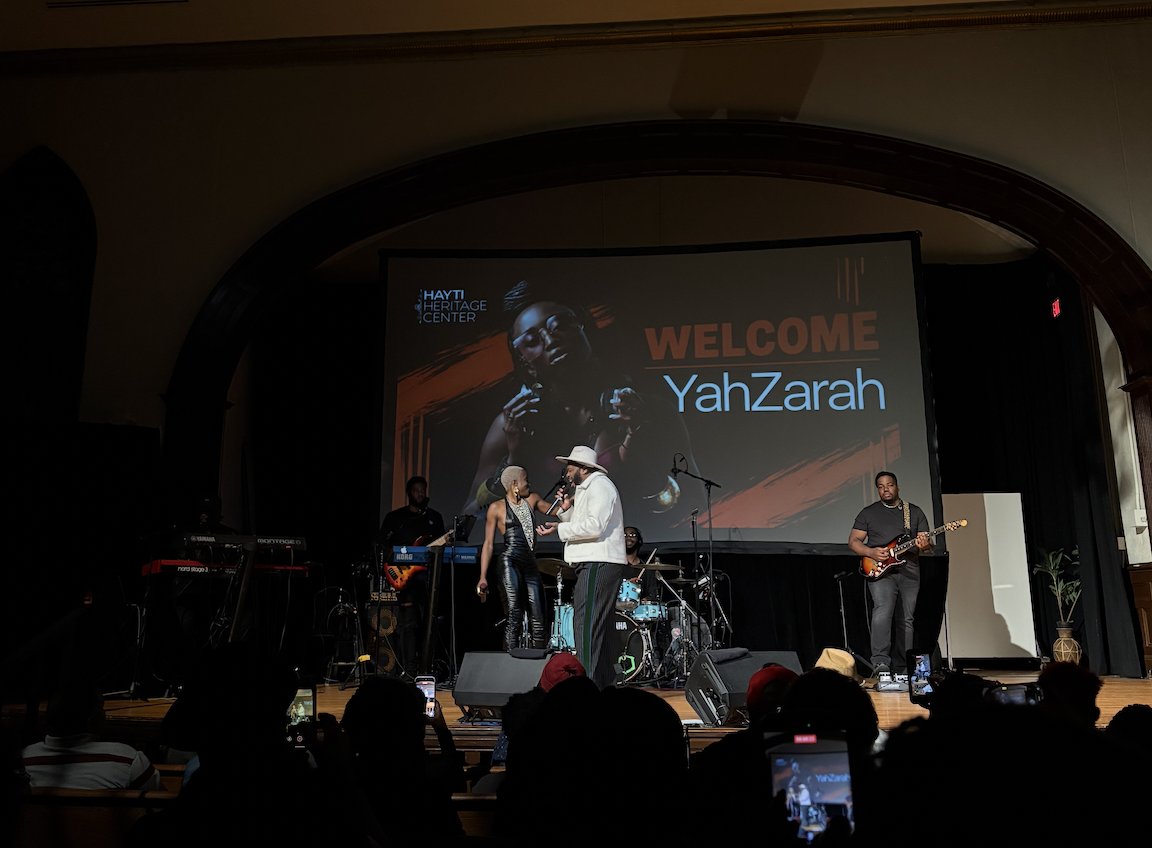
Credit: Molly Louison
YahZarah (left) performs alongside special guest Darien Brockington during her homecoming concert at the Hayti Heritage Center in Durham on Saturday, Oct. 10, 2026.
Entertainment
A Love Letter to Durham, Sung by YahZarah.
YahZarah returned to Durham’s Hayti Heritage Center on Oct. 10 to perform songs from her album "The Ballad of Purple St. James," much of which was partly inspired by her years in the city. The concert brought her before an audience of longtime friends and familiar faces, with performances and stories that revisited the relationships behind her music.
YahZarah had yet to sing a note, but the gathering at Durham’s Hayti Heritage Center on Saturday evening was already hosting small reunions. Friends greeted one another across the rows, exchanging embraces beneath the ornate ceiling of the former St. Joseph’s African Methodist Episcopal Church. Some wore North Carolina Central University varsity jackets that looked as though they had survived decades of homecomings.
The audience welcomed the center’s artistic director, Monèt Marshall, with laughter, applause and murmured approval. She said she hoped that guests would return often enough to wear a familiar groove into their seats, until each person knew exactly where they belonged.
The occasion was a homecoming concert for YahZarah, the singer and songwriter who first came to Durham at 19 on a jazz scholarship to NCCU. She returned Saturday to perform songs from her album The Ballad of Purple St. James, much of which was shaped by her years in the city.
Marshall borrowed a sentiment from YahZarah that seemed especially fitting for the evening.
“I can’t go anywhere if I don’t go home first,” YahZarah had said.
She has since performed with Erykah Badu, Lenny Kravitz, Prince and the Roots, and received a Presidential Lifetime Achievement Award. But many in Saturday’s audience had known her long before those accomplishments.
And the songs she brought home that evening belonged to an earlier chapter of her life, one that many in the audience had witnessed firsthand.
“No place like home,” she said, gesturing towards the crowd.
Her voice was enormous, rich and resonant, filling the former sanctuary with a sound that seemed too large to belong to any one person. She sang with an astonishing physicality, her body scarcely still long enough to catch its breath.
Even as the band carried the music beneath her, YahZarah seemed to inhabit every lyric, moving between exuberance and tenderness with remarkable ease.
“I promise to sing myself to an asthma attack for your enjoyment,” she said.
She danced through the audience, occasionally occupying one of their seats. Later, she acknowledged that everyone had paid for their particular places before asking them to stand, move closer and fill the empty spaces between one another.
The separation between performer and audience, already diminished by the familiarity of the crowd, grew smaller still.
When YahZarah asked how many people had known her years ago, nearly half the room raised their hands. Among them were people who remembered the younger woman whose early encounters with romance, disappointment and independence had furnished so much of her music.
“I’ve come a long way, and a lot of grown people in this room know how far,” she said.
Between songs, YahZarah spoke with the ease of a woman catching up with old friends, recounting adolescent infatuations and romantic disappointments with considerable humor.
“Now I’m going to sing a song for my prom date,” she said. “I still hate him.”
But beneath the humor was a more tender reckoning with the past. YahZarah had returned to a room full of people who remembered her younger self, and much of what she sang concerned the distance between that young woman and the person standing before them.
“Your future is bright no matter what your past looks like,” she told the audience.
Love, in all its complications, occupied much of the evening.
Before welcoming special guest and musical artist Darien Brockington, YahZarah spoke at length about the peculiar chemistry that draws two people together, the almost instinctive recognition of another person’s soul. She introduced him as a boy who had grown into a man and, eventually, one of her closest friends.
Their duet gave substance to her description. Within moments of beginning, YahZarah stopped the band, asking for something more atmospheric, something “beautiful.” When they began again, their voices entwined helplessly, suggesting years of affection, each seeming to anticipate the other’s phrasing.
As they moved closer and touched, their harmonies grew fuller, their love as evident in the performance as in the stories that preceded it.
Later, performing alone, her guest invited audience members to turn toward their neighbors and tell one another to leave their problems at the door. Beneath the old church ceiling, the gesture recalled the passing of peace, a brief exchange of goodwill between people who had arrived separately but were, for the evening, sharing something together.
YahZarah eventually reappeared from the back of the room, now dressed in a black leather dress, as the words “come a little closer” repeated through the hall.
For all her tenderness, YahZarah was equally interested in love’s less agreeable tendencies. Introducing another song, she considered eros, the passionate variety of love that the ancient Greeks associated with desire and that she suggested was particularly likely to get someone into trouble.
Her stories turned toward high school romances, adult relationships and eventually a former marriage. Recalling an argument with her then-husband, she described coming to understand that the foundations of a relationship could be less certain than they appeared.
“Love can sometimes be built on something untrue, and I’m ready to build it on me, not you,” she recalled realizing.
It was a revealing admission from a woman whose songs had so often celebrated the exhilaration of loving another person. With age has come a more complicated understanding of devotion, and a recognition that the love one gives to others must sometimes be reclaimed for oneself.
“Sometimes God can bless us with everything, and we still love our bondage,” she said, reflecting on the difficulty of leaving a relationship even after recognizing the pain it has caused.
There was something fitting about hearing these reflections in the old sanctuary. YahZarah, who began singing in a church choir as a child, seemed equally at ease with the language of faith and romantic longing. Her music moved between the earthly and the divine, between the love that might consume a person and the love that might sustain one.
And throughout the evening, there was Durham, whose affection for YahZarah appeared to have survived the years with remarkably little diminishment.
At the beginning of the concert, Marshall had encouraged the audience to make a home of their seats. YahZarah spent much of the night coaxing them out of those seats and toward one another.
The old church had spent more than a century gathering people in the name of love. On Saturday, there was another reason.
Share this article

Follow us

This puppy is preparing an AI Chatbot for you!
Latest articles

November 14, 2026

November 14, 2026
November 14, 2026
