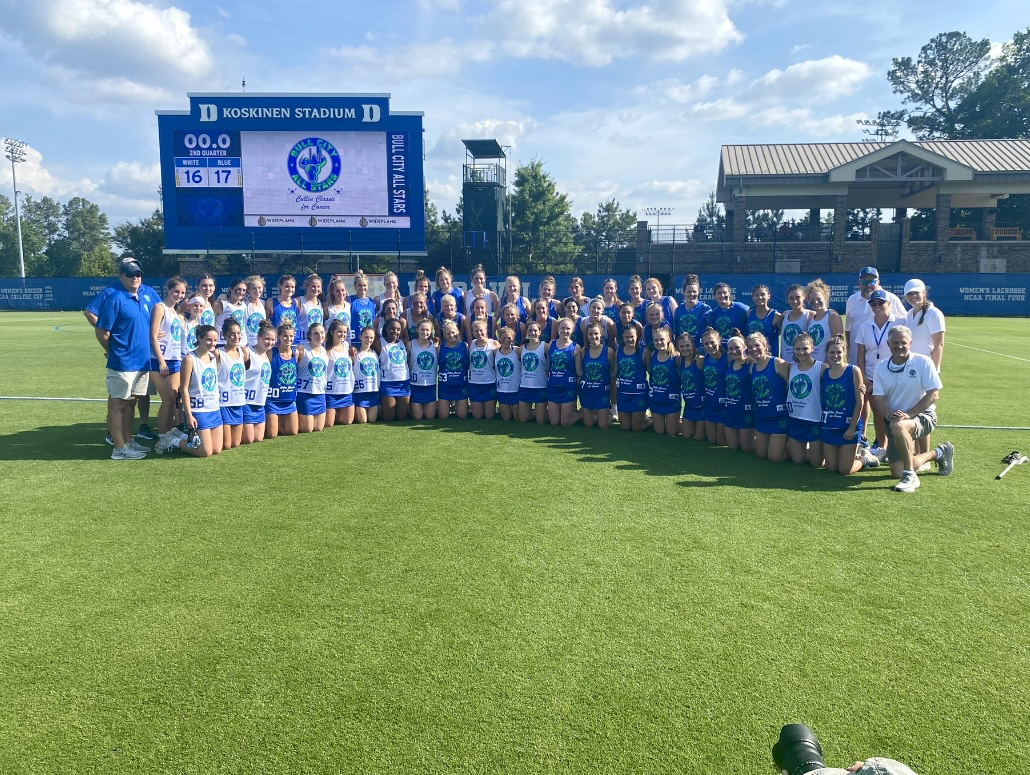
The 2023 women’s Team Blue and Team White pose for a team photo at Koskinen Stadium. Team Blue defeated Team White 17-16 in the Bull City All-Star Game: Cullen Classic for Cancer, where players, coaches and organizers gathered to honor Tony Cullen. Photo by Chelsea Sipple.
Community,Sports
Bull City All-Star Game highlights lacrosse growth, honors Tony Cullen
Each year, the Bull City All-Star Game: Cullen Classic for Cancer, brings North Carolina’s top high school lacrosse players to Koskinen Stadium, where the event highlights the sport’s growth while honoring the legacy of Tony Cullen.
At Koskinen Stadium, the Cullen Classic for Cancer event brings together North Carolina’s top high school lacrosse players for the Bull City All-Star Game, highlighting the sport’s growth brings together some of North Carolina’s top high school lacrosse players for an event that highlights the sport’s rapid growth in the region and honors one of its most influential figures.
Lacrosse in North Carolina, once considered a niche sport, has grown steadily over the past two decades, particularly in the Triangle. What was once limited to a handful of programs has expanded into a statewide network, with more than 8,000 athletes now playing at the high school level.
Jeff Spear, a longtime assistant coach at Leesville Road High School who has been involved in North Carolina lacrosse since 2012, has seen that growth firsthand. Over that time, the number of men’s varsity programs has at least doubled, while women’s programs have tripled, with especially rapid expansion in Wake County and along the coast.
“Helping ‘grow the game’ is one of the main goals of our event,” Spear said.
That expansion reflects both population growth and deeper local investment. As new residents brought experience from traditional lacrosse regions in the Northeast, they helped establish youth and high school programs across the state. Now, the sport is beginning to sustain itself locally, with former players returning as coaches.
“Seeing that the generational transition is exciting for older coaches,” Spear said.
Access remains uneven, particularly at the middle school level, where formal programs are still limited. Without early exposure, many athletes miss opportunities to develop foundational skills.
“If more schools funded, or at least officially recognized and supported their middle school teams, lacrosse would be more accessible across the economic spectrum,” Spear said.
Events like the Bull City All-Star Game aim to expand that access by increasing visibility and creating opportunity. Each year, the event brings together top graduating seniors from across North Carolina, dividing them into Team Blue and Team White for both men’s and women’s games. Held at Duke University, the setting places high school athletes in a collegiate environment.
That broader reach helps address gaps in exposure, giving players from less-established programs a chance to be seen alongside those from traditional powerhouses.
For players, the opportunity is both competitive and symbolic. It represents the culmination of years of work and a chance to be recognized among peers from across the state. For many, it is also one of their final organized games.
The event has also helped elevate the women’s game, which has historically received less attention and coverage.
“We’ve got just as many female players as we do males,” Kimberly Eastman Zirkle said. “I feel like it’s showcasing that they’re here, they’ve arrived as well.”
Beyond the field, the event has raised more than $100,000 over its first nine years for the Duke Cancer Institute and the North Carolina High School Athletic Association Tony Cullen Memorial Scholarship Fund. The money helps provide financial assistance to student-athletes while also supporting cancer research.
At the center of the event is Tony Cullen, whose legacy continues to shape lacrosse in North Carolina. A standout player at Duke, Cullen remains one of the program’s most prolific scorers despite playing only three seasons. He later returned as head coach, revitalizing a program that had been close to elimination and guiding it to national relevance.
Cullen’s impact extended beyond coaching. He became a mentor to coaches and officials across the state and later worked as a college referee, officiating ACC tournaments and NCAA championship games. He also served on the NCAA Rules Committee.
“Tony had such a great rapport, and people respected him,” said Franklin Zirkle, Co-founder and co-director of the Bull City All-Star Games, who has been coaching locally at the collegiate and high school level since 1984 and had the good fortune of officiating alongside Cullen.
After Cullen’s death from cancer, members of the lacrosse community looked for a way to honor his contributions. The All-Star Game emerged from that effort, combining recognition of top players with fundraising to support causes connected to Cullen’s legacy.
The idea gained traction through local connections and support from Duke’s athletic department. What began as a small initiative has grown into a statewide event.
“Historically, some similar events only highlighted players from the very top programs, while we cast a wide net in the nomination and selection process,” Spear said.
That approach has helped broaden recognition in the sport, ensuring that athletes from emerging programs are included alongside those from more established teams.
For organizers, the most meaningful moments often happen off the field. They point to the reactions of players and families experiencing a college venue for the first time.
“Just seeing the final product, if you’re up in the stands, looking down, and just watching the people enjoying it and cheering,” Franklin Zirkle said. “Just little things like that, to me, are the most rewarding.”
The event also serves as a point of connection across generations of players and coaches. It reinforces the idea that the sport’s growth depends on continued involvement beyond high school.
“Our hope, however, is that their connection with lacrosse doesn’t end after high school,” Spear said.
As the final whistle blows and players gather for photos under the stadium lights, the significance of the moment extends beyond the game.
For the Durham lacrosse community, the event represents both progress and possibility — a reflection of how the game has grown and a reminder of the role community support plays in sustaining it.
This year’s games are on Wednesday, June 3, 2026
Share this article

Follow us

This puppy is preparing an AI Chatbot for you!