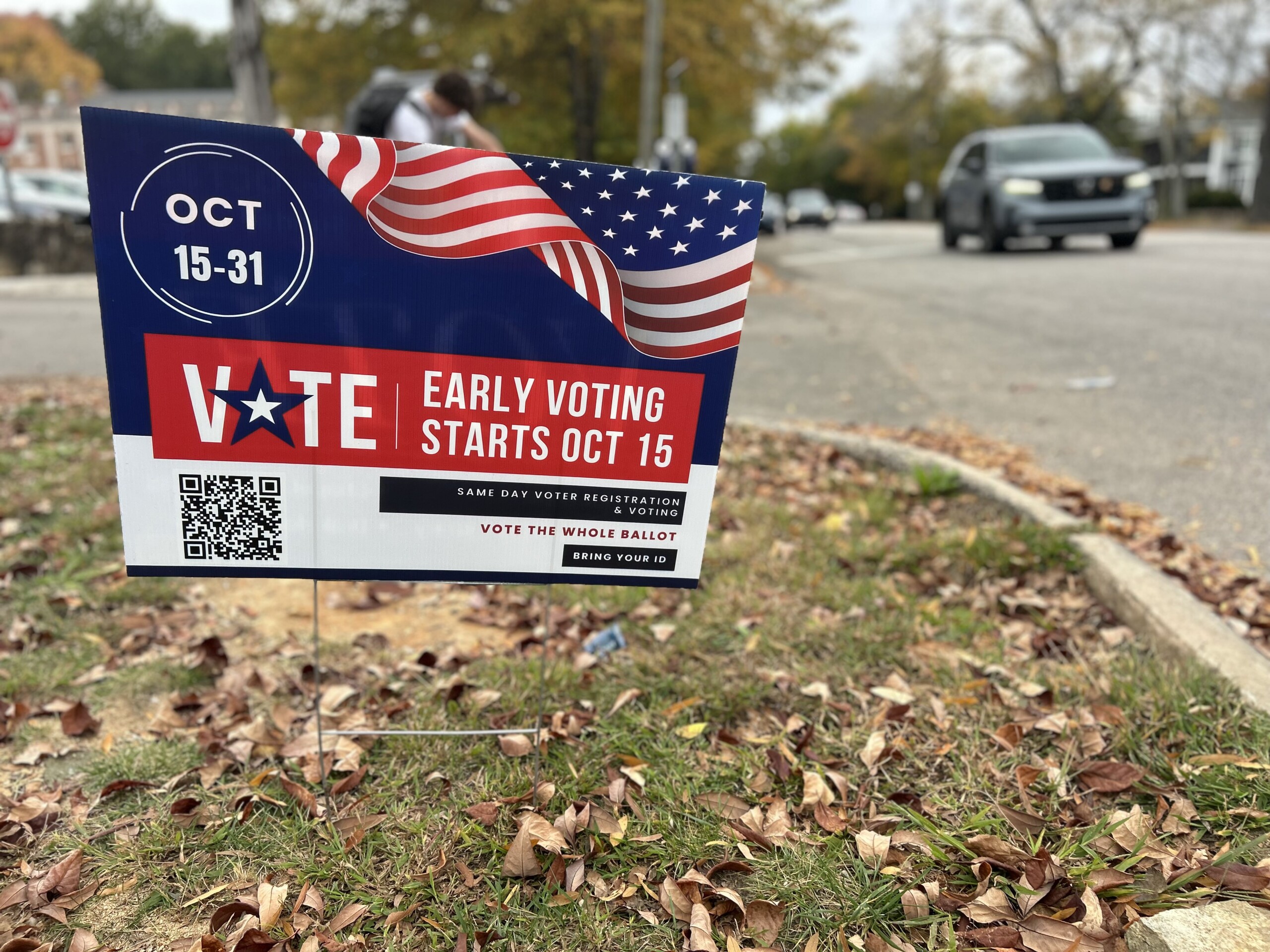
Election sign with voting information. Photo taken by Carly Evans
Government,Politics
Durham County Midterm Election Results 2026
High voter turnout and a sweep for the Democratic Party: Here are the midterm election results in Durham County.
On Nov. 3, Durham voted alongside the rest of the country in the midterm election to decide races for the U.S. Senate and U.S. House of Representatives, as well as state offices, including the North Carolina Supreme Court, Appeals Court and the state Senate and House of Representatives.
Durham County voters faced eight contested offices and three constitutional amendments. There were an additional 13 uncontested offices on the ballot, including the North Carolina District Attorney, Superior Court Judges and District Court Judges.
Heading into Election Day, the Durham County Board of Elections reported 253,616 registered voters with roughly 49% registered Democrats, 41% Unaffiliated, 9% Republicans and 1% Libertarians.
Nearly 45% of registered voters participated in early voting. As of Nov. 4, the North Carolina Board of Elections reported an overall voter turnout of nearly 60% in Durham County, roughly 6% more than the 2022 midterm election.
Here are the election results of North Carolina and Durham County as of Nov. 4.
U.S. Senate: Roy Cooper, Democrat
Former two-term Democratic Gov. Roy Cooper defeated Republican opponent Michael Whatley in a key U.S. Senate race with almost 59% of the vote across the state. Durham voters overwhelmingly supported Cooper, with 87% of the county’s votes. Cooper will become the state’s first Democratic senator in over a decade.
U.S. House of Representatives, District 4: Valerie P. Foushee, Democrat
Democratic incumbent Valerie Foushee beat Republican Mahesh Ganorkar with a vote of 79% to 19%. In Durham, 86% of voters opted for Foushee.
Foushee became the 4th District’s first Black and first female representative when she was originally elected in 2022. She was born and raised in Chapel Hill, working in the Chapel Hill Police Department and Chapel Hill-Carrboro City Schools Board of Education before being elected to the North Carolina General Assembly in 2012.
NC Supreme Court, Associate Justice Seat 1: Anita Earls, Democrat
Democratic incumbent Justice Anita Earls retained her seat against Republican candidate Sarah Stevens in a highly contested election with votes of 59% to 41%. Durham voters supported Earls, with 87% of the vote.
Earls has served on the North Carolina Supreme Court since 2019, previously working as a civil rights lawyer and law school professor.
NC Court of Appeals:
Judge Seat 1: John S. Arrowood, Democrat
Democratic incumbent John Arrowood defeated Republican Michael Byrne with 57% of the vote. Arrowood received nearly 86% of Durham’s vote.
Arrowood was originally elected to the Appeals Court in 2017.
Judge Seat 2: Tobias (Toby) Hampson, Democrat
Democratic incumbent Toby Hampson won reelection against Republican challenger George Cooper Bell in a vote of 57% to 43%. He won 86% of Durham votes.
Hampson has served as a Court of Appeals Judge since 2019.
Judge Seat 3: Christine Walczyk, Democrat
Democrat Christine Walczyk, the only woman running for election in the Court of Appeals, campaigned against Republican Craig Collins for the open Seat 3, winning with 57% of the vote and earning roughly 86% support among Durham voters.
Since 2007, Walczyk has served as the District Court Judge for District 10C.
NC State Senate, District 22: Sophia Chitlik, Democrat
Democratic incumbent Sophia Chitlik won against Republican LaKeshia Alston in a vote of 85% to 15%.
She has served as a state senator since winning the election in 2025.
NC House of Representatives, District 30: Marcia Morey, Democrat
Democratic incumbent Marcia Morey retained her seat against Libertarian Ray Ubinger, earning almost 93% of the vote.
Morey was appointed to the office in April 2017, having previously served as a district court judge and assistant district attorney for North Carolina District 14.
Constitutional Amendments
While Durham voters overwhelmingly opposed the state’s three proposed constitutional amendments with over 70% of votes against each referendum, all three passed in the statewide vote.
Across North Carolina, the proposed constitutional amendments of voter identification, income tax caps and property tax limits each received roughly 60% of the vote.
Results
All unofficial election results, including uncontested offices, from Durham County and North Carolina can be found through the North Carolina State Board of Elections.
Edited by Andy Zhao and Emmy Benton.
Share this article

Follow us

This puppy is preparing an AI Chatbot for you!
Latest articles
November 6, 2026

November 6, 2026
November 6, 2026
