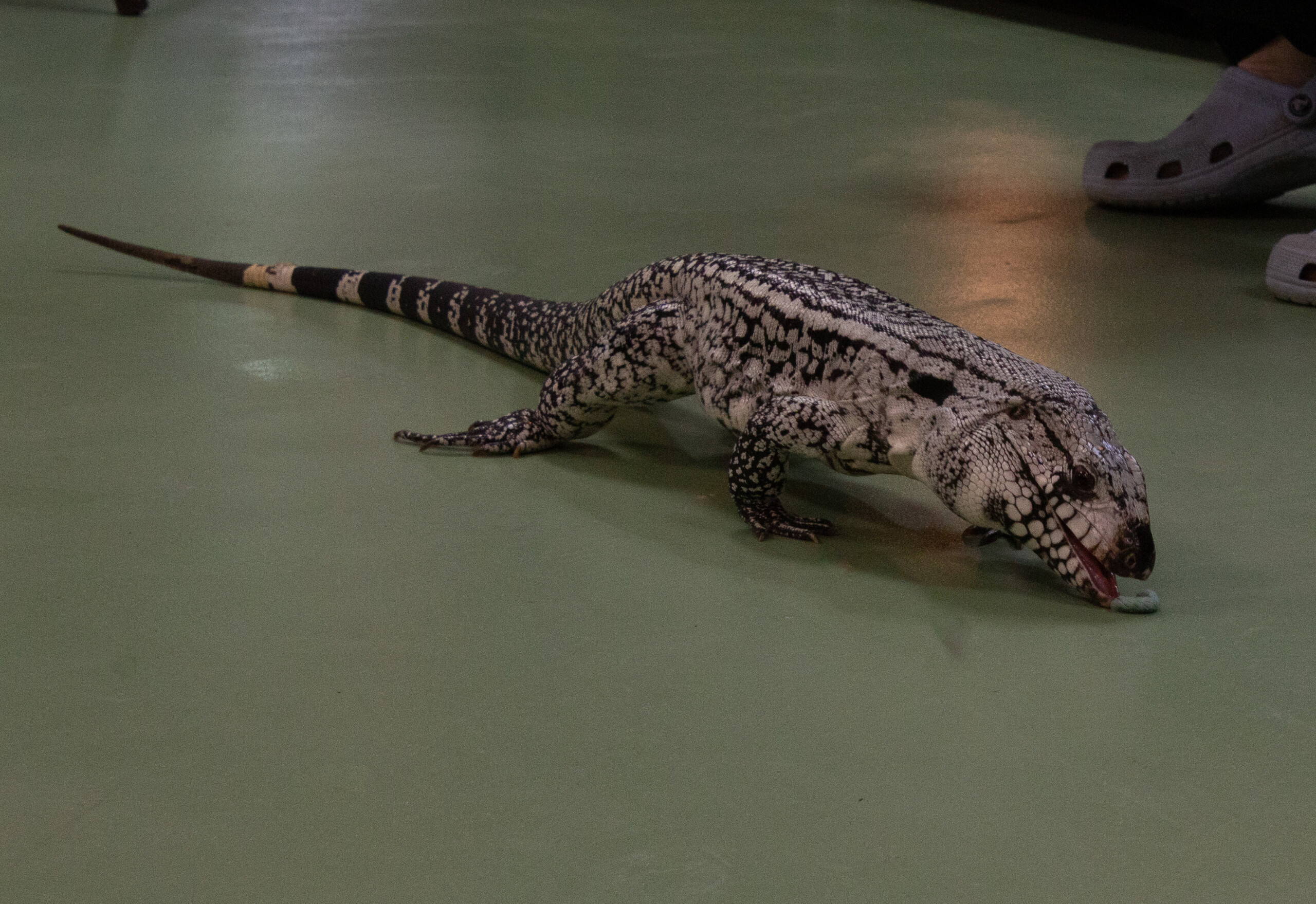
Dorian, the rescues tegu, runs across the floor chasing food.
Community
More than exotic pets: Inside Durham’s BeWild Reptile Rescue
Local organization urges responsible reptile ownership while caring for dozens of surrendered animals
The first thing visitors notice when you walk up to the rescue isn’t the noise—but the stillness.
A snake rests, coiled behind glass, its tongue flicking occasionally. Heat lamps cast a warm glow across rows of enclosures, each one holding a different species: geckos, turtles, spiders, and even an axolotl that has partially transitioned to life on land. A chameleon clings quietly to a branch nearby. In an enclosure outside, a rescued owl blinks slowly, watching as we explore.
Then, suddenly, the calm shifts.
More than 10 volunteers file in within minutes, grabbing supplies and moving with practiced efficiency. Buckets clatter, cages open and close, and conversations overlap as everyone quickly gets to work cleaning, feeding, and checking on animals. It’s organized chaos; evidence of how much care this place requires every single day.
Some animals leave behind their own kind of mess—smudges across glass enclosures that volunteers jokingly refer to as “finger paintings.” It’s a small reminder that every space here is lived in and constantly maintained.
At BeWild Reptile Rescue in Durham, the work of volunteers is constant.
“We started in 2018 focusing on education,” said Nicole D’Avignon, co-director of BeWild. “But rescue quickly became the main focus because there’s such a big need in this area.”
D’Avignon, who is set to graduate from veterinary school at NC State in the next two weeks, co-founded the organization with AJ Hallat after working together in wildlife rehabilitation and wanting to create something with stronger animal welfare standards and transparency. Once D’Avignon graduates, she plans to take on even more of the animals’ medical care herself.
What began as a small educational effort with ambassador reptiles has grown into a full-scale rescue operation.
Today, rescue work makes up the majority of BeWild’s time, funding, and volunteer efforts.
“We currently have over 60 animals on our waitlist,” D’Avignon said. “People sometimes have to wait months to surrender an animal.”
She said that demand often stems from a common issue: a lack of understanding about how to properly care for reptiles and other exotic animals.
“Some of our worst cases come from people who just don’t know any better,” she said. “They’ll buy a reptile from a pet store, trust the advice they’re given, and not realize these animals can live 15 years or more and require very specific care.”
Inside the rescue, those consequences are visible, but so are the recoveries.
D’Avignon said several animals that arrived malnourished or sick are now slowly regaining strength. Some require months of careful feeding and medical attention before improving, and recovery can be especially slow for reptiles.
“We do get cases that are too far gone,” she said. “But seeing the ones that recover—that’s the most rewarding part.”
Not all of the animals rescued are in critical condition. About half serve as “ambassadors,” traveling to schools, festivals, and community events to help educate the public.
“About half of our animals will go out for educational programs,” D’Avignon said. “The others stay here because they have special needs or just aren’t comfortable being handled.”
One of the most memorable reptile residents, however, isn’t always confined to his enclosure.
Dorian, a large tegu, has a spacious habitat of his own but is often allowed to roam under supervision. This sometimes catches first-time visitors off guard. During one visit, he wandered across the floor, pausing to drag himself slowly along as he scent-marked his surroundings before suddenly deciding to chase after a snack. Equal parts fascinating and chaotic, Dorian is a guest favorite.
While he roams, it’s hard not to stop and stare, especially for visitors who have never seen anything like him before.
Moments like that make BeWild feel approachable, but they also highlight a deeper message.
“Just because they’re not furry doesn’t mean they’re not important,” D’Avignon said. “They deserve the same level of care as a dog or cat.”
Volunteers are essential to make a high level of care possible. Many volunteers come in multiple times a week, helping with everything from cleaning enclosures to preparing food.
Melissa Cornwell, who heard about BeWild while searching online for volunteer opportunities, said she quickly became deeply involved.
“For a while, I was coming two or three times a week,” she said. “One of my favorite experiences was working at the NC State vet school open house—getting to hold snakes and talk to kids. I used to be that kid.”
Riley Baker, a newer intern at BeWild, said the experience has been eye-opening. He is now considering applying for veterinary school at North Carolina State University.
“I’ve learned a lot about the different care requirements for all these animals,” Baker said. “It’s been really cool to see how much goes into it.”
That education, both for volunteers and the broader community, is central to BeWild’s mission.
For D’Avignon, the goal is simple: help people understand the responsibility that comes with owning a reptile before it becomes a rescue case.
“A lot of these situations are preventable,” she said. “We just want people to be informed.”
As the number of surrendered animals continues to grow, D’Avignon’s message is becoming increasingly important—not just for the animals already at BeWild, but for those that may need help in the future.
Edited by: Kyla McGhee, Gianna D’amato, and Bella Cashman
Share this article

Follow us

This puppy is preparing an AI Chatbot for you!
Latest articles
October 25, 2026
October 25, 2026

October 25, 2026
